
What Is Product-Market Fit?
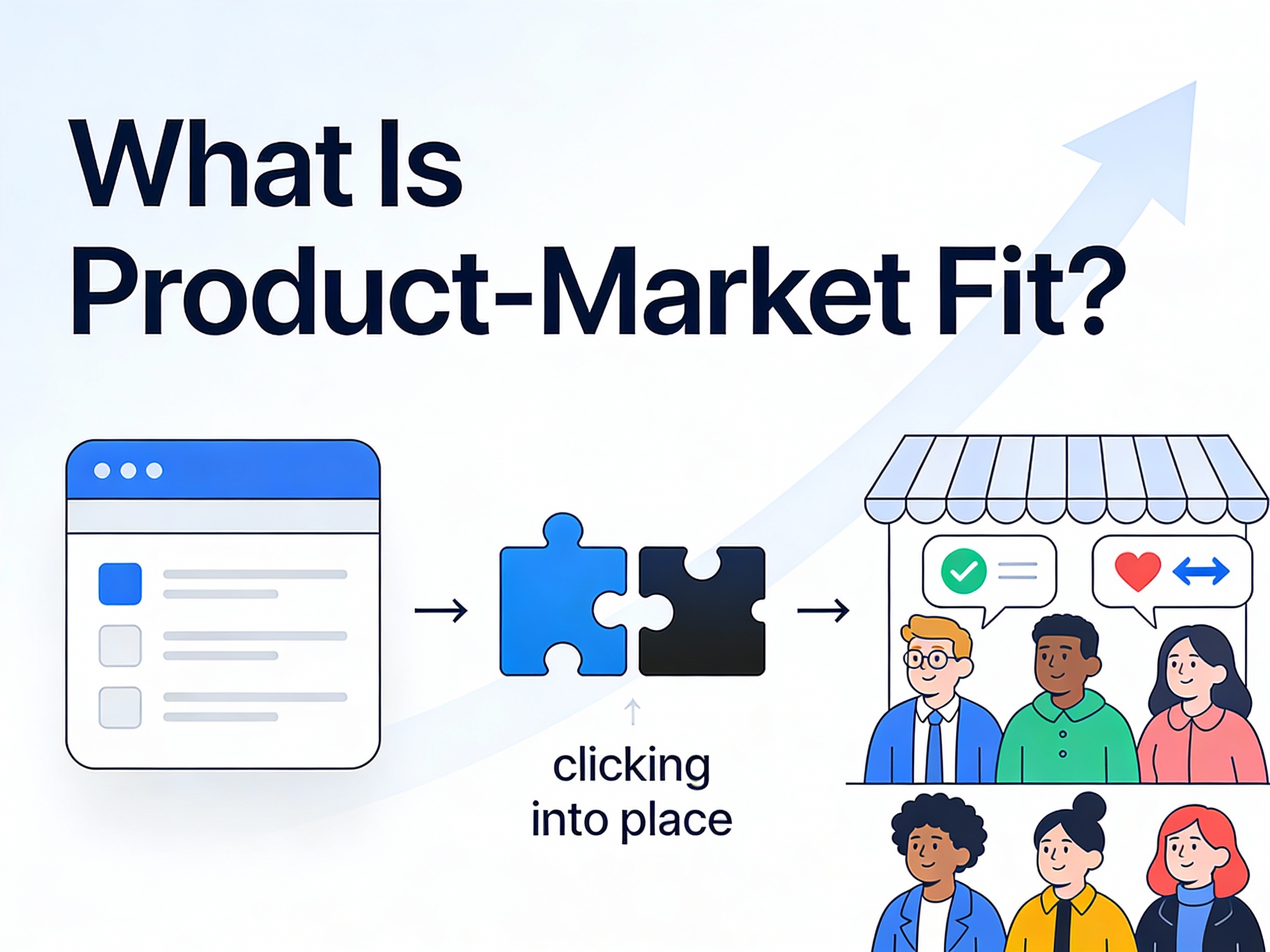
Product-Market Fit (PMF) is the point where your product meets real, strong demand in the market. It’s when you’ve built something that solves a genuine problem for a specific group of people, and they’re buying it, using it repeatedly, and recommending it to others.
According to Marc Andreessen, who popularized the term: “Product-market fit means being in a good market with a product that can satisfy that market.”
More concretely, product-market fit means:
-
Your target customers are actively buying your product
-
They’re using it regularly and finding real value
-
They’re keeping it (low churn rate)
-
They’re telling others about it (word-of-mouth growth)
-
Your company is sustainable and profitable (or trending that way)
It’s the inflection point where growth starts happening more naturally, where customer acquisition becomes easier, and where you stop questioning whether people actually want what you’re building.
Why Product-Market Fit Matters
Product-market fit is the difference between a struggling startup and a scaling company. It’s why:
1. Scaling Becomes Possible
Without PMF, you throw money at customer acquisition and the customers leave (high churn). With PMF, customers stick around, spend more, and bring others. Growth becomes repeatable.
2. Fundraising Gets Easier
VCs invest in companies with proven product-market fit. They’d rather fund a slower-growing business with PMF than a faster-growing business still searching for it.
3. Team Morale Improves
When customers love your product, when growth is happening, when you’re getting positive feedback, people want to work on your product. Hiring becomes easier.
4. You Stop Second-Guessing Everything
Without PMF, every metric is questioned. With PMF, you know your core value works. You can shift focus to scaling, not survival.
5. Capital Efficiency Improves
With PMF, you need less money to grow. Customer acquisition costs drop (referrals), lifetime value increases (retention), and the unit economics work.
The Reality: What Product-Market Fit Feels Like
Before Product-Market Fit
-
You have to convince people to use your product
-
Customer acquisition is expensive (high CAC)
-
Customers use it once then leave (high churn)
-
You’re constantly questioning: “Do people actually want this?”
-
Growth is slow and painful
-
Supporting the business requires constant effort and money
-
Team morale fluctuates with each customer conversation
-
Every metric is being analyzed for hidden signs of promise
After Product-Market Fit
-
Customers come to you (inbound interest)
-
People organically tell others about your product (word-of-mouth)
-
Customers keep using it (low churn)
-
You hear consistent feedback: “This solves a real problem I have”
-
Growth is happening naturally
-
Unit economics work (LTV > CAC)
-
The team is energized; recruitment is easier
-
You’re confident enough to invest in scaling
Signs You’ve Found Product-Market Fit
Qualitative Signs (What Customers Say)
1. Genuine Frustration When It Doesn’t Work
When your product has downtime or a bug, customers complain. They didn’t expect to lose access, they’ve incorporated your product into their workflow. Before PMF, customers wouldn’t care. After PMF, they’re upset it’s unavailable.
2. Specific, Product-Centric Feedback
Before PMF: “Is this for me?”
After PMF: “Can you add feature X?” or “Can you integrate with Y?”
Customers stop asking whether they need it and start asking how to get more value from it.
3. Customers Expand Usage
They use it for more departments, more use cases, more people. They’re investing in getting more value.
4. Questions Shift from “How Do I Use This?” to “How Do I Maximize This?”
Customer support goes from “How does this work?” to “What’s the best way to use this for our specific situation?”
5. Unprompted Referrals & Recommendations
Customers tell their colleagues, friends, or peers without you asking. They’re evangelists because they genuinely believe in your solution.
6. Customers Stick Around Through Pricing Increases
When you raise prices, most customers stay. This signals they see value that justifies the cost.
Quantitative Signs (What Metrics Show)
Core Metrics of Product-Market Fit:
1. Customer Retention Rate > 90% (B2B SaaS)
Customers keep paying month-to-month. Monthly churn under 5-8% is healthy. This is the single strongest indicator.
2. Net Promoter Score (NPS) > 40-50
Customers would recommend you to others. NPS = (Promoters % – Detractors %). Anything above 40 is strong; above 50 is exceptional.
3. Organic Referrals: 20-30%+ of New Customers
A significant portion of new customers come from existing customers recommending your product, not from paid marketing.
4. Revenue Growth > 15% Month-Over-Month
Without increased marketing spend. The product’s inherent value is driving growth.
5. Customer Acquisition Cost (CAC) < Customer Lifetime Value (LTV) ÷ 3
Rule of thumb: If CAC is $100, LTV should be $300+. Ideally, you want LTV to be 3-5x your CAC. With PMF, unit economics work.
6. Sales Team Hitting Targets with Ease
Sales teams consistently hitting or exceeding 100%+ of quota. They’re not struggling to sell; customers are eager to buy.
7. Time-to-Close Shortens
Sales cycles get faster because customers understand the value quickly. Less education needed.
8. Organic/Inbound Traffic Growing 20%+ Monthly
SEO, content, word-of-mouth, and organic channels are working because people are searching for solutions like yours.
Real Benchmark Data:
-
Retention rate: Average B2B SaaS: 92-97% monthly. PMF companies: 95%+
-
NPS: Average: 30-40. PMF companies: 50-70+
-
Organic referrals: Average: 10-20%. PMF companies: 25-40%
-
Growth rate: Average: 5-10%. PMF companies: 15-30%+
How Long Does It Take to Find Product-Market Fit?
Timeline Expectations
The honest answer: It varies, but plan for 12-24 months for most businesses.
Industry-Specific Timelines:
B2B SaaS: 18-24 months
-
Longer sales cycles require more proof
-
Complex implementation extends validation
-
Enterprise deals take time
Consumer Apps: 6-12 months (if viral)
-
Can be faster if you hit organic growth
-
But sustainability takes longer to prove
-
Retention is harder to achieve
Marketplaces: 18-36 months
-
Chicken-and-egg problem (need both supply and demand)
-
Liquidity takes time to achieve
-
Most challenging category
Hardware: 24-48 months minimum
-
Prototyping phase: 6-12 months
-
Manufacturing validation: 6-12 months
-
Distribution building: 6-12 months
Developer Tools: 12-18 months
-
Developers adopt quickly
-
But monetization takes longer
-
Need to prove ROI to justify paid plans
Famous Company Timelines
Companies that had massive success still took time:
| Company | Timeline | Notes |
|---|---|---|
| Dropbox | 1 year | Fast validation; clear problem |
| Loom | 1 year | Built on existing platform; niche focus |
| Airbnb | 2 years | Marketplace complexity; traveled to verify |
| Slack | 3 years | Started as internal tool; iterated slowly |
| Stripe | 2 years | Needed trust; payment processing requires proof |
| DoorDash | 2 years | Marketplace with liquidity challenges |
| Figma | 3 years | Deep tech; browser-based design was novel |
| 2+ years | Unclear market initially; many pivots |
Key Insight: Even obviously successful companies took 18-36 months. Don’t panic if you’re at month 12 and still refining.
How to Know You’re Close to Product-Market Fit
| Signal Area | Green Lights (Close to PMF) | Yellow Lights (In the Search) | Red Lights (Not There Yet) |
|---|---|---|---|
| Customer Usage | Customers actively using (not just installed) | Uneven usage across segments | Customers can’t explain why they use it |
| Retention | Retention stabilizing (70%+) | Uneven retention by segment | Churn > 10% monthly |
| Referrals / Growth | Organic referrals happening (10%+) | Low organic referrals; reliance on paid | No organic growth signal |
| NPS / Customer Love | NPS 40+ with some promoters | NPS under 40 | NPS < 30 |
| Unit Economics | Unit economics trending positive | Unit economics don’t work yet | Unit economics don’t work |
| Sales Motion | Sales cycle shortening | Sales team struggling with messaging | Sales team wants to pivot; founder-dependent sales |
| Customer Feedback | Feedback becoming more specific and actionable | Feedback is contradictory | Feedback unclear or shallow |
Product-Market Fit Journey by Stage
Stage 1: Validation (Months 0–3)
| Aspect | Details |
|---|---|
| Goal | Confirm people have the problem and would pay for a solution |
| Key Actions | Interview 30–50 target customers about pain pointsAsk if the problem is painful enough to change behaviorValidate willingness to pay (“Would you pay $X?”)Build a simple MVP (no over-engineering)Get 3–5 early adopters using itCollect feedback systematically |
| Success Metrics | 80%+ interviews confirm the painWillingness to pay validatedMVP core features workingEarly adopters actively engaging |
| Common Mistake | Building too much before talking to customers |
Stage 2: Problem–Solution Fit (Months 3–6)
| Aspect | Details |
|---|---|
| Goal | Prove the solution solves the problem better than alternatives |
| Key Actions | Get 10–20 early active usersTrack feature usage and workflowsAsk how work has changed since using the productMeasure DAU/WAUCollect qualitative feedbackIterate based on insights |
| Success Metrics | Users achieving measurable resultsWAU > 50%Strong qualitative value feedbackClear use cases emergingNet retention trending positive |
| Common Mistake | Adding too many features instead of deepening the core solution |
Stage 3: Go-to-Market Fit (Months 6–12)
| Aspect | Details |
|---|---|
| Goal | Prove you can acquire, retain, and monetize customers |
| Key Actions | Formalize ICPBuild repeatable sales/marketing processMeasure CAC and LTVDevelop positioning and messagingTest acquisition channelsRefine pricing |
| Success Metrics | LTV:CAC > 3Predictable conversion rates70%+ monthly retentionNPS 40+10–20% organic referrals |
| Common Mistake | Spending heavily on paid acquisition before PMF is clear |
Stage 4: Scale Phase (Months 12–24+)
| Aspect | Details |
|---|---|
| Goal | Scale confidently with a proven product |
| Key Actions | Increase sales & marketing spendBuild distributionExpand to adjacent segmentsOptimize unit economicsHire for growth |
| Success Metrics | 90%+ monthly retentionNPS 50–70+25–40%+ organic referrals20–50%+ MoM revenue growthClear path to profitability |
Common Paths to Product-Market Fit
Path 1: First Idea Is Right (20–30%)
| Aspect | Details |
|---|---|
| What Happens | Idea → Validation → Product → Customers love it → Scale |
| Examples | Dropbox, Loom, Stripe |
| Key Factors | Deep market understandingObvious, painful problemClear (but non-obvious) solutionWillingness to charge early |
Path 2: Multiple Pivots (50–60%)
| Aspect | Details |
|---|---|
| What Happens | Initial idea fails → Variations tested → Customer-driven pivot → PMF found |
| Examples | Slack, Twitter, Figma, Segment |
| Key Factors | Willingness to challenge assumptionsRegular customer feedbackFast pivot cyclesGood judgment on which feedback to follow |
| Pivot Types | Target customer pivotProblem pivotFeature pivotPlatform pivot |
Path 3: Market Expansion (10–15%)
| Aspect | Details |
|---|---|
| What Happens | Product works in one market → Expansion → New market becomes primary |
| Examples | Slack, Figma |
| Key Factors | Following market signalsUnderstanding new customer needsFast product adaptation |
Path 4: Niche Focus (Increasingly Common)
| Aspect | Details |
|---|---|
| What Happens | Hyper-focus on one niche → Dominate niche → Expand later (optional) |
| Examples | SpotOn (beauty industry), Notion (specific workflows) |
| Key Factors | Deep niche knowledgeHighly tailored workflowsStrong community building |
Conclusion: Product-Market Fit Is The Foundation
Product-market fit is the difference between a company with a future and a company with an expiration date.
Without PMF:
-
You’re constantly struggling for traction
-
Growth requires constant effort and money
-
Team morale varies with each new customer conversation
-
You’re always one pivot away from failure
With PMF:
-
Growth is increasingly natural
-
Customers come to you
-
Team is energized
-
You can focus on execution, not survival
-
You know you’ve built something that matters
The path to PMF looks different for every company. Slack took 3 years and a pivot. Airbnb took 2 years of personally photographing apartments. Dropbox hit it in 1 year. There’s no fixed timeline.
What matters is:
-
Customer focus: Are you obsessed with understanding what customers need?
-
Willingness to pivot: Are you willing to change course when data says you should?
-
Retention focus: Are you measuring and optimizing for retention above all?
-
Speed: Are you iterating fast enough to learn quickly?
-
Honesty: Are you being honest about whether customers actually love your product?
Start by finding problem-solution fit. Then work toward go-to-market fit. Then scale confidently.
Product-market fit isn’t a destination you arrive at once. It’s an ongoing process of staying close to customers, listening to their feedback, and making sure your product remains relevant to their needs.
But that inflection point, when you know you’ve got something real, that’s unmistakable.
Aim for it. The effort is worth it.