
Introduction
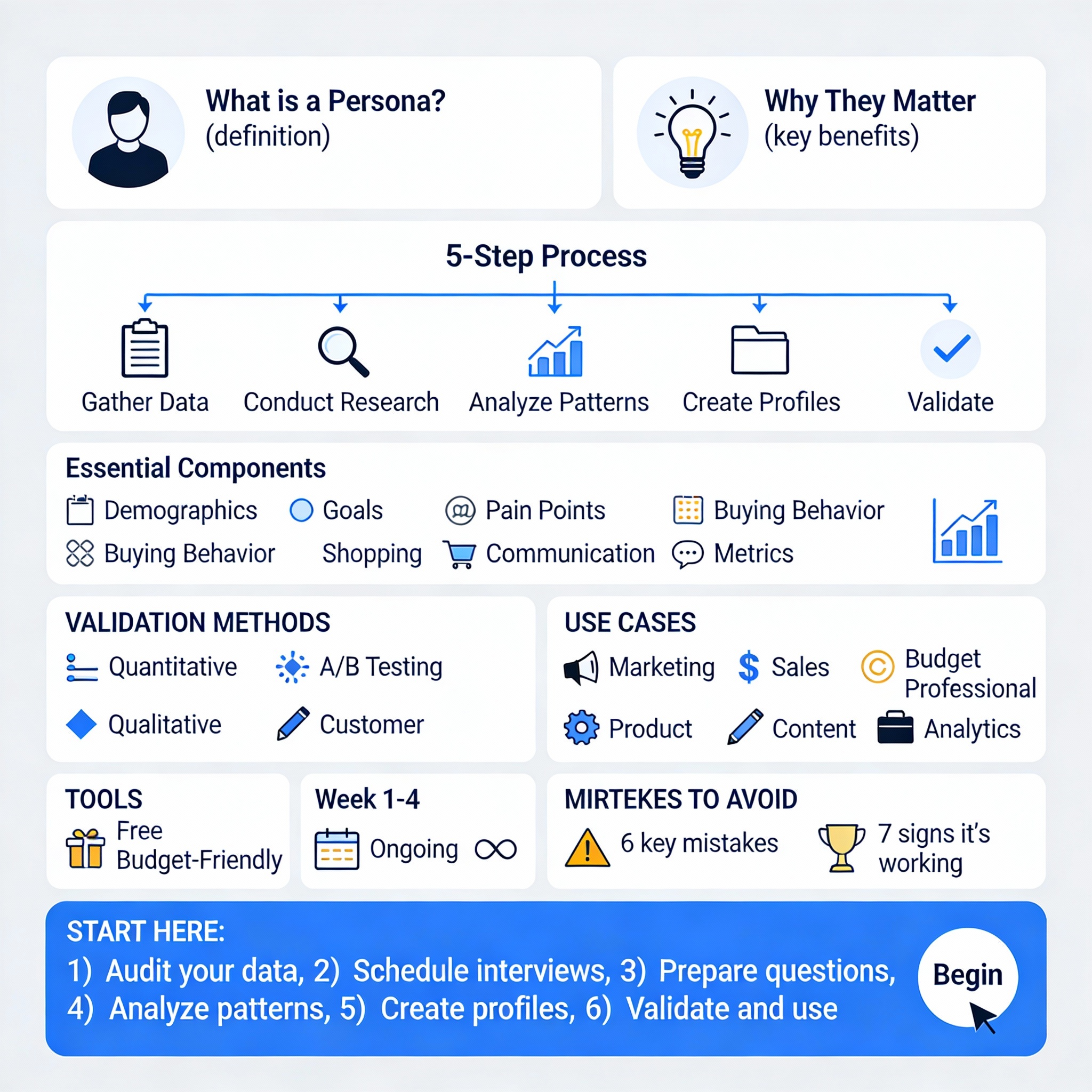
A customer persona is a semi-fictional representation of your ideal customer or buyer based on real data, research, and insights. Personas combine demographic information, behavioral patterns, goals, pain points, and motivations to create detailed profiles that guide product development, Product marketing strategy, sales conversations, and customer experience design.
Companies that implement persona-based personalization see 20% faster sales cycles and 15% increase in marketing efficiency, according to Forrester research. Whether you’re in B2B SaaS, e-commerce, or product development, creating accurate personas is foundational to business success.
Why Customer Personas Matter
Business Impact
- Marketing & Sales Alignment: Personas help sales and marketing teams speak the same language about who they’re targeting, aligning pitches, content, and campaigns.
- Product Development: Product teams use personas to prioritize features and design decisions that address real customer pain points.
- Content Strategy: Personas helps product marketers to use the info to make content, from blog posts to email campaigns to product documentation, ensuring messaging resonates with actual audience needs.
- Customer Experience: Understanding your personas deeply allows you to design experiences that delight specific customer segments.
- Budget Efficiency: Focused marketing on the right personas reduces wasted ad spend and improves ROI.
- Improved Conversions: Targeted messaging based on persona motivations increases conversion rates by 10-20% compared to generic campaigns.
The Complete Process for Creating Personas
Step 1: Gather Existing Customer Data
Before conducting interviews, analyze all available customer data you already have.
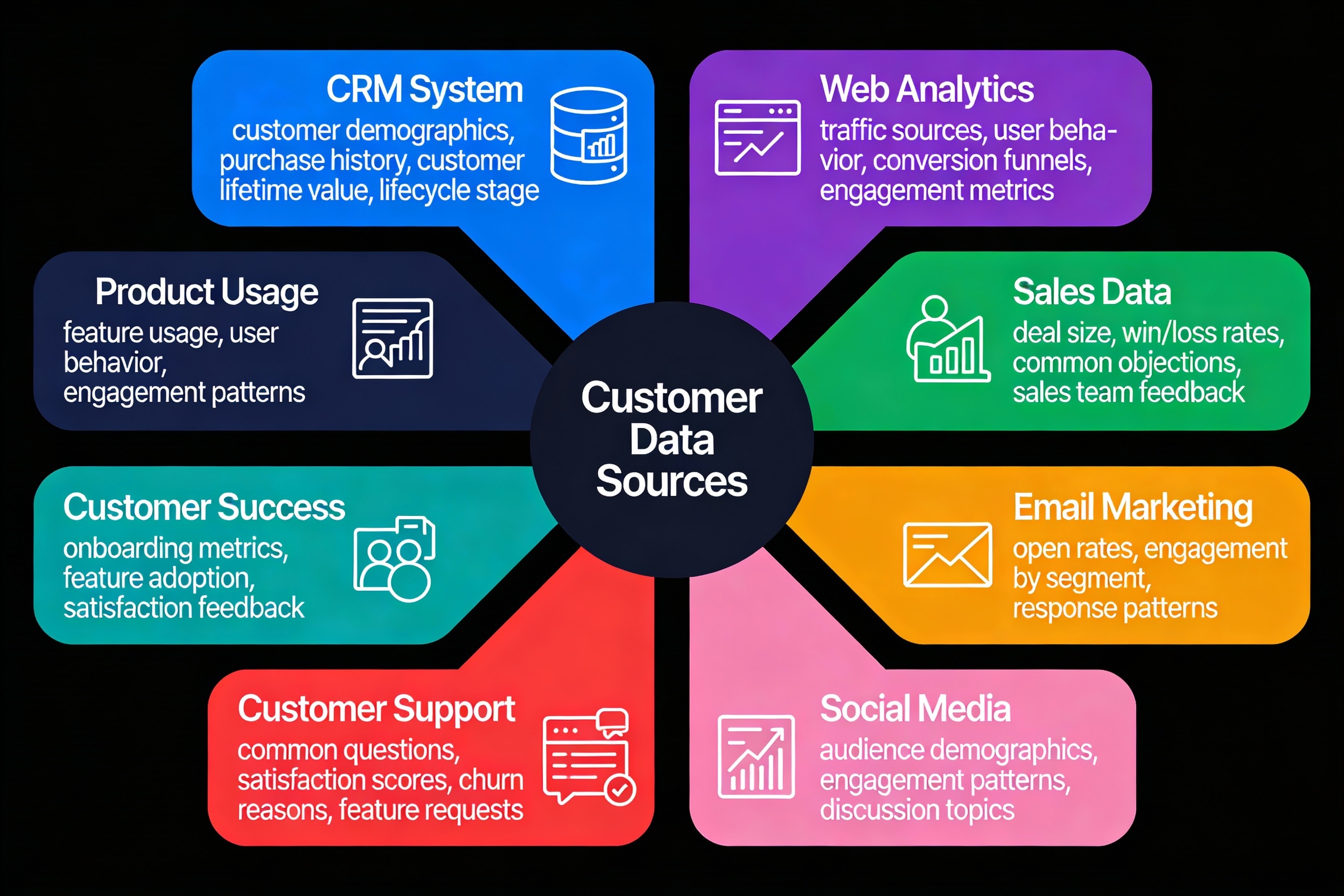
Data Sources to Explore
Customer Relationship Management (CRM) System
-
Analyze customer demographics: age, location, company size, industry
-
Review purchase history and patterns
-
Look at customer lifecycle stage (new, active, at-risk, churned)
-
Calculate customer lifetime value (CLV) by segment
-
Identify your highest-value customers and what they have in common
Web Analytics (Google Analytics, Mixpanel)
-
Traffic sources: Where do visitors come from? (Search, social, direct, ads)
-
User behavior: What pages do they visit? How long do they stay?
-
Conversion funnels: Where do people drop off?
-
Device and location data
-
Engagement metrics: Time on site, pages per session, bounce rate
Sales Data
-
Deal size and average contract value (ACV) by customer segment
-
Sales cycle length
-
Win/loss rates against competitors
-
Common objections raised during sales conversations
-
Sales team feedback on customer types and their needs
Email Marketing Metrics
-
Open rates and click rates by audience segment
-
Which content drives engagement?
-
Email list segments and their characteristics
-
Response patterns by persona type
Customer Support & Service Data
-
Common questions and issues reported
-
Support ticket themes
-
Customer satisfaction scores (NPS, CSAT)
-
Churn reasons (from churned customer conversations)
-
Feature requests and feedback
Social Media Insights
-
Audience demographics on each platform
-
Engagement rates by content type
-
What topics generate discussion?
-
Platform preferences for your audience
-
Social listening on competitor products
Analysis Tasks
-
Segment Your Customers: Group customers by characteristics (company size, industry, revenue, use case)
-
Identify Patterns: Look for common traits, behaviors, and outcomes within each segment
-
Find Your Best Customers: Who has highest lifetime value, retention, and satisfaction?
-
Note the Gaps: What customer types are you missing? What segments underperform?
-
Calculate Percentages: What percentage of customers fit each pattern?
Tool Tip: Use spreadsheets or data visualization tools (Tableau, Looker) to spot patterns visually.
Step 2: Conduct Qualitative Research (Interviews)
Numbers show what happened; conversations reveal why. Interviews are essential for understanding motivations, decision-making processes, and the emotional drivers behind purchases.
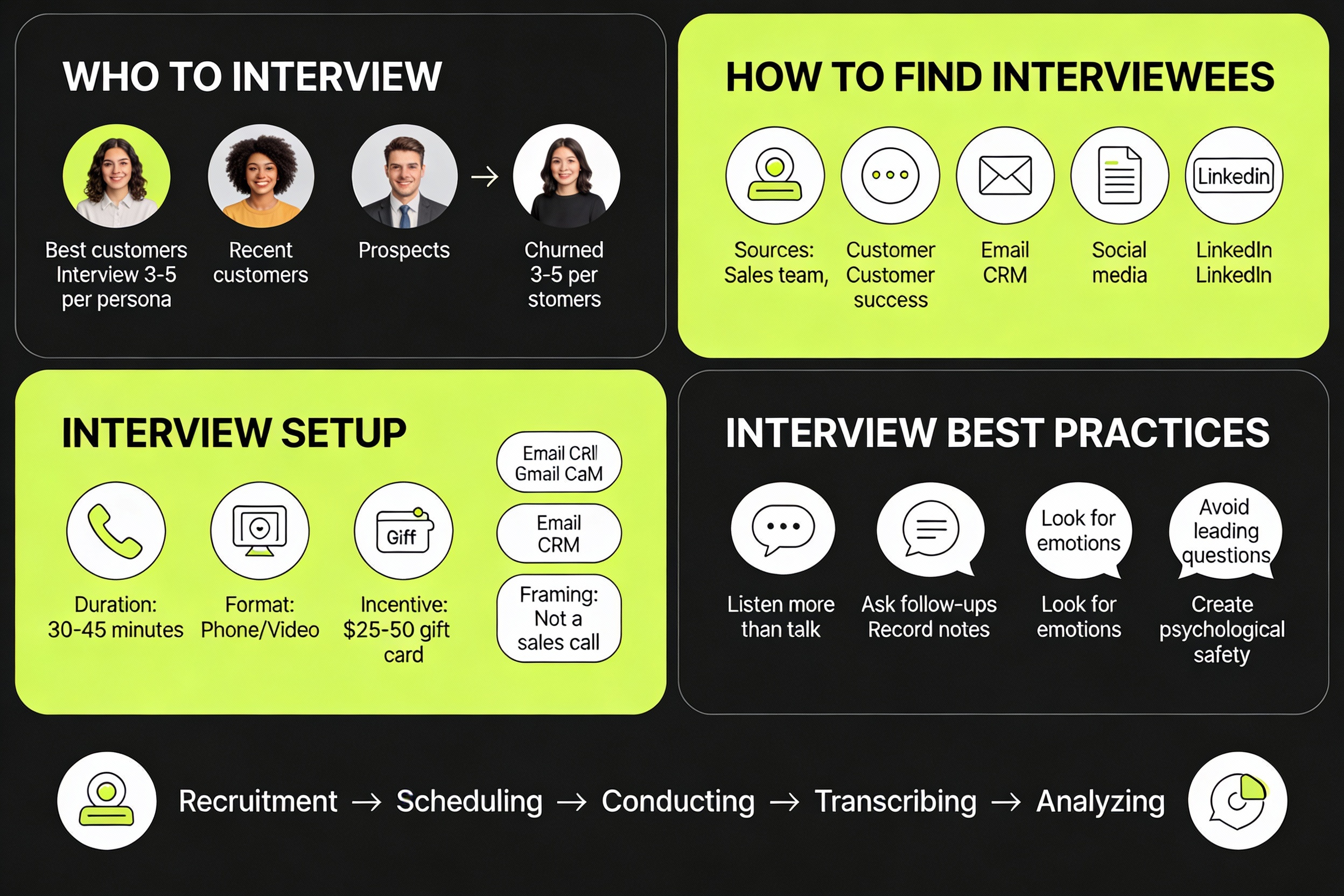
Who to Interview
Target 3-5 people per persona. Interview a mix of:
-
Best customers: Your most satisfied, longest-retained, highest-value customers
-
Recent customers: Those who just purchased (fresh perspective on buying journey)
-
Prospects: People interested but haven’t bought yet (learn objections)
-
Churned customers: Those who left (understand pain points)
-
Adjacent personas: If your product serves multiple user types, interview each type
Where to Find Interviewees:
-
Ask your sales team to identify typical customers they work with
-
Request customer success teams to suggest satisfied customers
-
Email your CRM for willing participants (offer incentive: $25-50 gift card)
-
Use social media or communities to find prospects
-
LinkedIn for B2B interviews
Interview Preparation
Duration: 30-45 minutes (respect their time)
Format: Phone or video call (in-person is better for observational research)
Incentive: Offer a small gift card or discount ($25-50) to boost participation
Framing: Make clear this is research to understand their needs, NOT a sales call
Key Interview Questions to Ask
Section 1: Background & Role (5 minutes)
-
What’s your job title and primary responsibilities?
-
How long have you been in this role?
-
What does a typical day look like for you?
-
What tools and software do you use daily?
-
Who do you report to? Who reports to you?
Section 2: Goals & Objectives (5 minutes)
-
What are your top 3 goals this year (professionally)?
-
What’s most important for you to achieve in your role?
-
How does success get measured in your role?
-
What’s preventing you from reaching these goals right now?
Section 3: Pain Points & Challenges (8 minutes)
-
What’s your biggest challenge at work?
-
What keeps you up at night? (frustrations, worries)
-
How are you currently solving this problem?
-
What annoys you about current solutions?
-
What does an ideal solution look like?
Section 4: Product/Solution Usage (8 minutes)
-
How did you first learn about [our product/category]?
-
What was your buying process like?
-
Who else was involved in the decision?
-
What criteria were important in choosing [our product]?
-
What’s working well? What’s frustrating?
Section 5: Buying Behavior (5 minutes)
-
How long was your buying process?
-
What resources did you consult (Google, analyst reports, colleagues, competitors)?
-
What would have made the buying process easier?
-
What almost prevented you from buying?
-
What was the deal-breaker for competitors you rejected?
Section 6: Communication & Information (4 minutes)
-
Where do you spend time online (LinkedIn, Twitter, blogs, podcasts)?
-
How do you stay updated on industry trends?
-
What blogs, publications, or thought leaders do you follow?
-
How do you prefer to communicate (email, phone, Slack)?
-
How often do you want to hear from vendors?
Section 7: Open-Ended Closing (2 minutes)
-
Is there anything else I should know about you or your role?
-
Can you tell me a story about [related challenge]? (asks for narrative, reveals values)
-
What would you tell a peer considering [our product]?
Interview Best Practices
- Listen More Than You Talk: Your job is to understand, not to convince.
- Ask Follow-Up Questions: “Tell me more about that…” or “Can you give me an example?” uncovers deeper insights.
- Record Notes: Take detailed notes (with permission, record audio if possible for later review).
- Look for Emotions: Note not just what they say, but how they feel about it.
- Avoid Leading Questions: Don’t ask “Don’t you love [feature]?” Instead, ask “What do you think about [feature]?”
- Create Psychological Safety: People are more honest when they feel respected and not judged.
Step 3: Analyze and Identify Patterns
With research data collected, look for common themes across interviews and data.
Pattern Analysis Process
-
Read Through All Data: Review interview notes, CRM data, and support tickets
-
Highlight Recurring Themes: What gets mentioned multiple times? What’s similar across customers?
-
Group by Similarity: Create clusters of customers with shared characteristics
-
Count Frequency: How many interviews mentioned each theme? (50% or more = strong pattern)
-
Identify Outliers: Which customers are different? These might be separate personas or less important segments
Common Patterns to Look For
-
Shared Goals: What do multiple customers want to achieve?
-
Similar Pain Points: What problems come up repeatedly?
-
Consistent Objections: What concerns multiple prospects raise?
-
Decision Triggers: What events/changes motivated them to buy?
-
Information Sources: Where do they get industry information?
-
Communication Preferences: How do they like to be contacted?
-
Personality Traits: Are they risk-averse or experimental? Collaborative or solo?
-
Success Measures: How do they define winning?
Step 4: Create Detailed Persona Profiles
With patterns identified, create comprehensive written profiles for each persona.
Essential Persona Components
A complete persona includes:
1. Basic Demographics
-
Fictional name (e.g., “Marketing Manager Maria” or “IT Ian”)
-
Photo or avatar (search stock images, don’t use real people)
-
Age range
-
Job title and role
-
Industry/company type
-
Company size (if B2B)
-
Location/geography
-
Education level
2. Professional Background
-
Years in current role
-
Career path/progression
-
Team size managed (if applicable)
-
Tools and technologies used
-
Key responsibilities
3. Goals & Motivations (Top 3-5)
For each goal, include:
-
The specific goal (e.g., “Increase marketing team efficiency by 30%”)
-
Why it matters to them
-
How they measure success
-
Timeline for achieving it
Example:
Goal 1: Increase Pipeline Velocity
Maria needs to reduce the sales cycle from 90 days to 60 days. Success is measured by average deal cycle time. This matters because her CEO is pushing for faster growth, and her bonus depends on pipeline metrics.
4. Pain Points & Challenges (Top 3-5)
For each challenge:
-
What is the problem?
-
Why is it frustrating?
-
What’s the current solution?
-
What’s inadequate about the current solution?
-
Impact if not solved (urgency)
Example:
Pain Point 1: Lead Quality
The marketing team generates lots of leads, but many are unqualified. Sales complains they waste time on bad leads. This wastes both marketing and sales time. Maria doesn’t have good criteria to filter leads, and sales doesn’t explain what makes a lead qualified.
5. Buying Behavior & Decision Criteria
-
How long is the typical buying process?
-
Who else is involved in the decision?
-
What information sources do they consult?
-
What are common objections?
-
What would make them choose a competitor?
-
What’s their budget approval process?
-
How do they evaluate options? (features, price, vendor reputation, etc.)
6. Preferred Communication & Information Channels
-
Email preferences (frequency, tone)
-
Social media platforms they use
-
Industry publications/blogs they follow
-
Webinars/events/podcasts they consume
-
Preferred sales contact method
-
Best time to reach them
-
Type of content that resonates (case studies, ROI calculators, webinars, whitepapers, etc.)
7. Personality & Working Style
Use spectrums to show personality traits:
-
Risk-averse ←→ Experimental
-
Collaborative ←→ Independent
-
Detail-oriented ←→ Big-picture thinker
-
Cautious ←→ Action-oriented
-
Data-driven ←→ Intuitive
8. Success Metrics & KPIs
What does Maria measure?
-
What KPIs is she responsible for?
-
How does her company measure her performance?
-
What would a win look like?
9. Current Situation vs. Ideal State
| Aspect | Current State | Ideal State |
|---|---|---|
| Lead Quality | 20% conversion rate | 40%+ conversion rate |
| Sales Cycle | 90 days | 60 days |
| Team Productivity | Manual processes, scattered tools | Integrated platforms, automated workflows |
| Data Insights | Fragmented reports | Single integrated dashboard |
10. Authentic Quote
Include a direct quote from an interview that captures this persona’s essence:
“We’re generating tons of leads, but we’re wasting too much sales time on bad fits. If we could just be smarter about qualifying upfront, I think our deal cycle would improve significantly.” – Marketing Director, B2B SaaS Company
Detailed Persona Examples
Example 1: B2B Marketing Manager Persona
Name: Maria Garcia
Title: Senior Marketing Manager
Age: 35-45
Company: Mid-sized SaaS company (100-500 employees)
Industry: B2B Software
Experience: 8 years in marketing, 3 years in current role
Daily Responsibilities:
-
Lead a team of 3 marketing managers
-
Manage $500K annual marketing budget
-
Report to VP of Marketing
-
Oversee demand generation, content, and brand strategy
Top 3 Goals:
-
Increase Marketing-Sourced Pipeline by 40% (from $3M to $4.2M annually)
-
Success measured by MQL → SQL conversion rate and pipeline contribution
-
Needs better lead scoring and nurturing
-
-
Improve Marketing & Sales Alignment
-
Have sales teams actively use marketing collateral
-
Reduce “I prefer my own pitch” resistance
-
Success measured by sales adoption metrics
-
-
Demonstrate Marketing ROI
-
Prove every marketing dollar generates $X in pipeline
-
Secure budget for new initiatives
-
Success measured by marketing attribution analysis
-
Top 3 Pain Points:
-
Lead Quality Issues
-
Generates lots of leads, but many are unqualified
-
Sales complains: “These aren’t real opportunities”
-
Current solution: Manual scoring, incomplete data in CRM
-
Inadequacy: High false positive rate, poor visibility into actual quality
-
Impact: Wasted sales time, executive pressure on pipeline
-
-
Budget Justification Challenges
-
Executives question marketing ROI and budget allocation
-
Feels like “marketing is a cost center, not a profit driver”
-
Current solution: Creates monthly reports, limited attribution
-
Inadequacy: Can’t tie specific campaigns to closed deals
-
Impact: Losing budget battles to sales, can’t fund growth initiatives
-
-
Sales Team Adoption of Content & Tools
-
Spends time creating sales collateral that sales doesn’t use
-
Sales teams prefer their own decks over marketing materials
-
Current solution: Sends out templates, but low adoption
-
Inadequacy: No accountability for using materials
-
Impact: Duplicated work, inconsistent messaging
-
Buying Behavior:
-
Buying process: 45-60 days
-
Decision makers involved: VP of Marketing, VP of Sales, Director of Demand Gen
-
Information sources: G2 reviews, Gartner reports, peer recommendations, LinkedIn
-
Objections: “Will sales actually use this?” “How long to implement?” “Can you show ROI?”
-
Deal-breaker for competitors: Poor CRM integration, difficult implementation
Preferred Channels:
-
Email: 2-3 times/week with actionable insights, avoid fluff
-
Social: LinkedIn primarily (industry articles, case studies)
-
Content: Case studies, ROI calculators, webinars, one-sheets
-
Events: Industry conferences, marketing summits
-
Best to reach: Mornings (8-10am), avoid Friday afternoons
Personality Profile:
-
Risk-aversion: ←●──────→ (slightly risk-averse; wants proof before investing)
-
Collaboration: ───●────→ (prefers collaborative solutions)
-
Detail-oriented: ●─────────→ (detail-oriented; wants comprehensive data)
-
Action-oriented: ────●───→ (balanced; wants quick wins + long-term strategy)
Success Metrics (Measures):
-
Marketing-sourced pipeline contribution
-
Lead conversion rates (MQL→SQL→Opportunity→Closed Won)
-
Sales team adoption rate of collateral
-
Marketing campaign ROI
-
Time-to-productivity for new marketing campaigns
Current vs. Ideal:
| Aspect | Current | Ideal |
|---|---|---|
| Lead Quality | 20% MQL→SQL conversion | 40%+ conversion with better scoring |
| Sales Usage | 30% adoption of marketing collateral | 80%+ adoption with incentives |
| Attribution | “Best guess” based on last touch | Multi-touch attribution model |
| Time-to-Launch | 4-6 weeks for new campaigns | 1-2 weeks; faster iteration |
| Team Efficiency | Constant back-and-forth with sales | Clear playbooks; self-service |
Key Quote:
“We’re creating amazing content, but sales isn’t using it because it doesn’t match their sales process. I need a solution that helps me prove what’s working and gets the entire organization aligned around the same metrics.” – Maria Garcia, Senior Marketing Manager
Why This Matters:
Maria represents a key decision-maker at mid-market companies. She controls significant budget, needs measurable ROI, and has competing priorities. Winning Maria means understanding her pressure from executives, her relationship challenges with sales, and her desire for better visibility into performance.
Persona Templates and Frameworks
Basic Persona Template
Use this structure to document each persona:
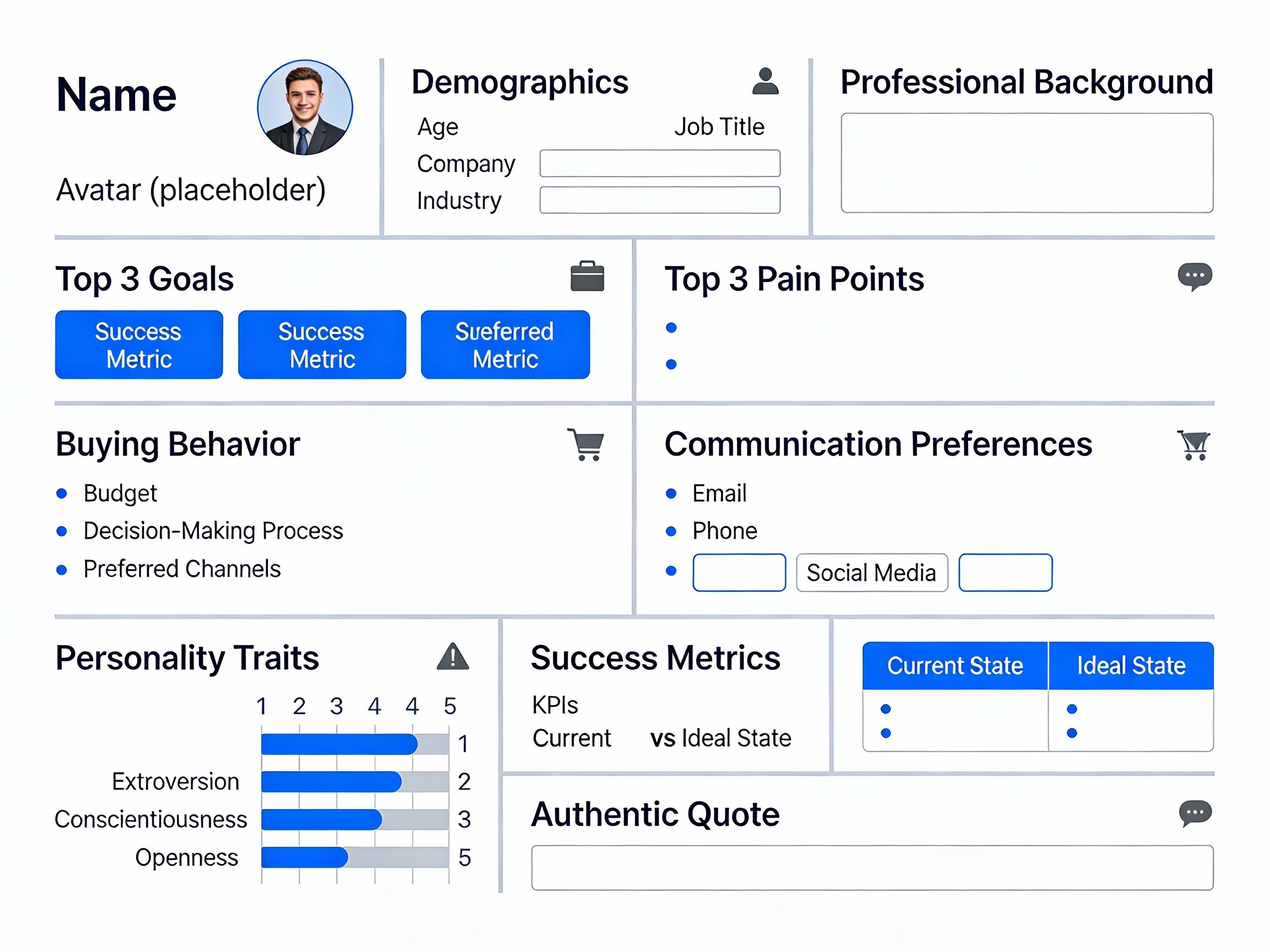
Access : Free Customer Persona Template
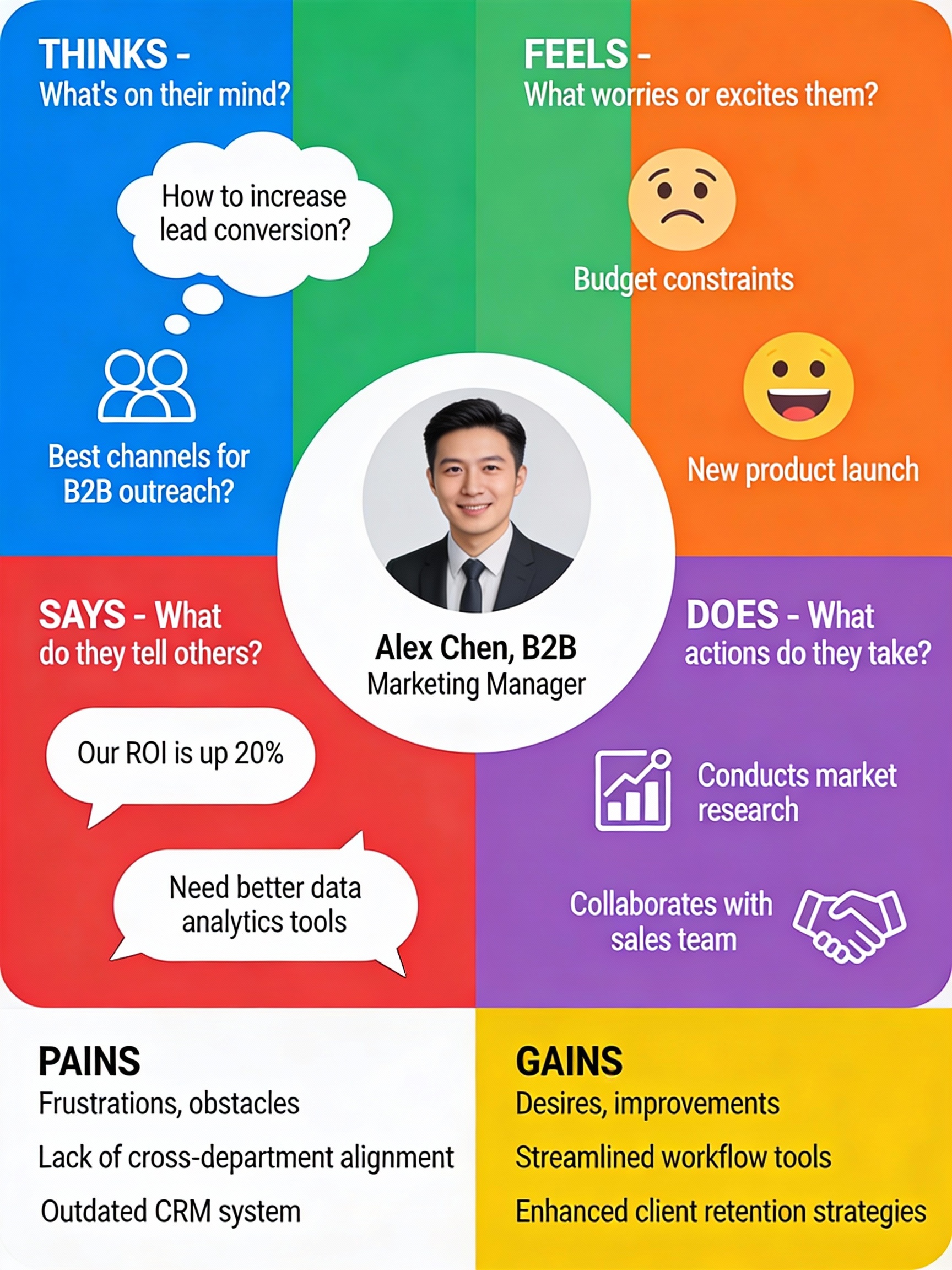
Framework: The Empathy Map
Empathy maps help you deeply understand a persona beyond just demographics.
Framework: Jobs-to-Be-Done (JTBD)
Go deeper by understanding the jobs your persona is trying to accomplish.
Format: “[Persona] wants to [Job] so that [Outcome]”
Examples:
-
“Maria wants to demonstrate marketing ROI so that she can justify increasing her marketing budget.”
Validating Your Personas
Creation is just the start. You must validate that your personas accurately reflect real customer behavior.
Validation Methods
1. Quantitative Validation: Analytics Data
Compare persona attributes against actual user behavior:
-
Demographics: Do your CRM demographics match persona age ranges, job titles, company sizes?
-
Traffic Sources: Does traffic come from channels where personas spend time?
-
Conversion Rates: Do different user segments convert at rates implied by personas?
-
Engagement Patterns: Do users engage with content types personas prefer?
-
Churn Patterns: Do users with persona attributes we predicted churn or retain?
Tool: Google Analytics, your CRM, Mixpanel
2. A/B Testing: Persona-Specific Messaging
-
Email Subject Lines: Test formal vs. casual tones; ROI-focused vs. problem-focused
-
Landing Page Variations: Test benefit-focused headlines vs. feature-focused for each persona
-
Ad Creative: Compare emotional appeal vs. product spec messaging
-
CTAs: Test different urgency levels or value propositions by persona
Example test:
-
Variant A (for Maria): “Prove Marketing ROI in 30 Days”
-
Variant B (for Maria): “Turn Your Lead Quality Metrics Around”
3. Qualitative Validation: Sales/Support Teams
-
Ask sales team: “Do these personas look like customers we actually sell to? What’s missing?”
-
Review support tickets: Do the pain points we listed show up in customer service issues?
-
Ask customer success: Are persona goals and success metrics accurate based on onboarding calls?
-
Review lost deals: Do objections match what personas say they’d worry about?
4. Customer Interview Follow-Up
-
Share personas back: Show personas to existing customers; ask, “Is this you?”
-
Test assumptions: Ask follow-up questions about assumptions you made
-
Measure alignment: “How accurate is this persona? 1-10, what would make it better?”
5. Market Validation
-
Run campaigns for each persona: See which personas respond best
-
Track conversion by persona: Which personas convert faster or at higher rates?
-
Monitor NPS by persona: Which personas are most satisfied?
-
Survey new customers: Ask incoming customers which persona they fit; correct as needed
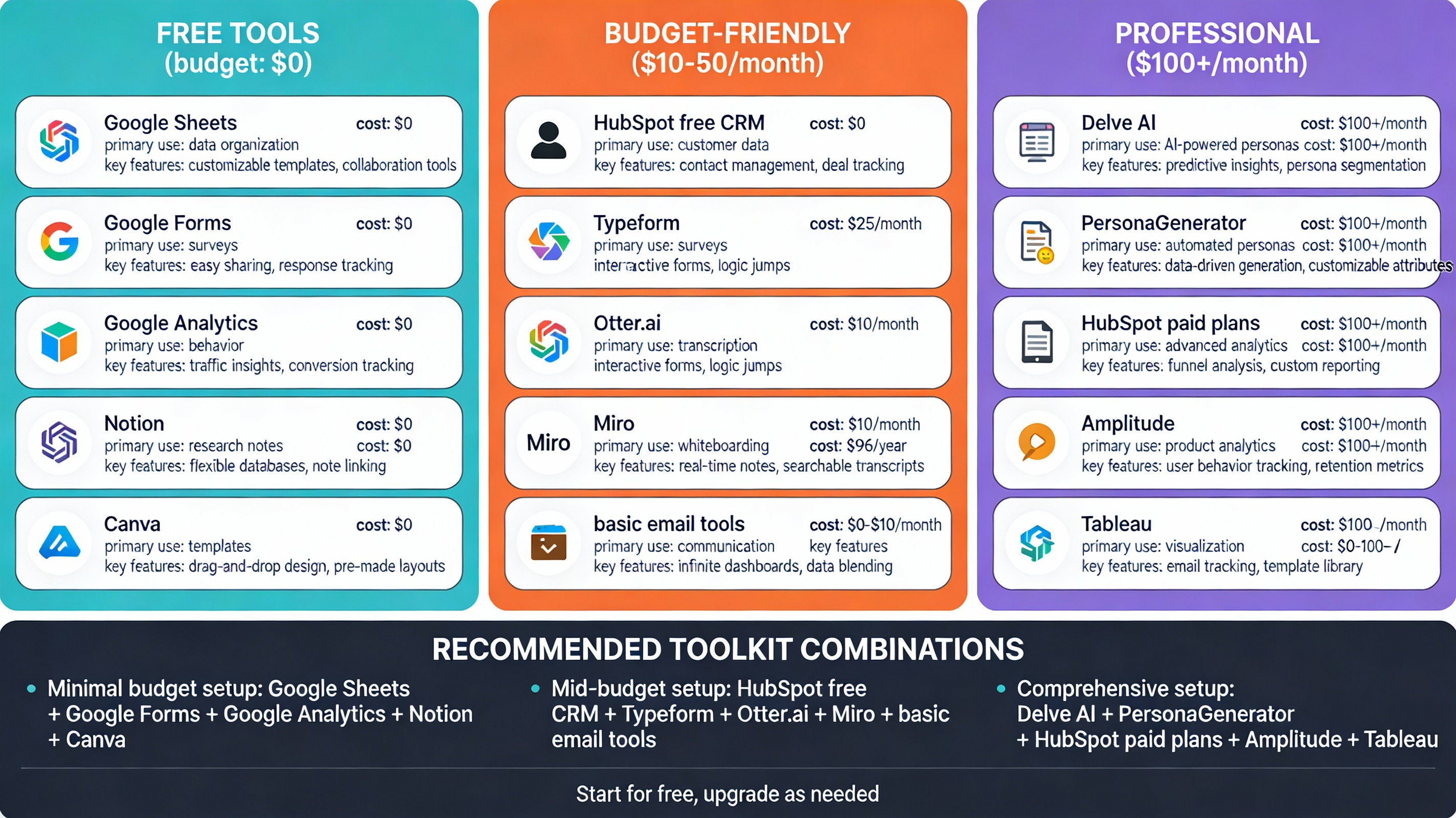
Tools for Creating Personas
Free/Low-Cost Tools
Spreadsheets
-
Google Sheets or Excel for organizing research
-
Create comparison tables
-
Track interview notes
Survey Tools
-
Typeform (free up to 100 responses)
-
Google Forms (free)
-
SurveyMonkey (free limited version)
Note-Taking
-
Notion (free tier)
-
OneNote (free)
-
Google Docs (free)
Templates & Visualization
-
Milanote (free)
-
Miro (free board)
-
Canva (free templates)
Professional Tools
Persona Software
-
HubSpot (free + paid plans; included with CRM)
-
Typeform + analysis
-
Delve AI (AI-powered persona generation from interviews)
-
PersonaGenerator (automated persona creation)
Analytics
-
Google Analytics (free)
-
Mixpanel (free tier)
-
Amplitude (free tier)
Interview Recording/Transcription
-
Otter.ai (transcribes interviews)
-
Descript (video transcription)
-
Rev.com (professional transcription)
Collaboration
-
Miro (collaborative whiteboarding)
-
Figma (design and collaboration)
-
Slack (team discussion)
Conclusion
Customer personas are one of the highest-ROI activities you can do in marketing and product. They transform abstract “target audience” thinking into concrete understanding of real people, their problems, and their motivations.
The most effective personas:
-
Are based on real data and research, not guesses
-
Go deep into motivations, not just demographics
-
Are actively used by marketing, sales, and product teams
-
Are regularly validated and updated
-
Drive specific decisions about strategy and tactics
Start with one or two core personas representing your highest-value customers. Invest in real research, interviews and data analysis. Create detailed profiles that bring personas to life. Then, use those personas consistently across all customer-facing work.
The investment pays dividends in better marketing ROI, higher conversion rates, improved product-market fit, and stronger customer relationships.