
QUICK SUMMARY
This complete guide explains how to become a Product Marketing Manager in 2026. It covers skills, roadmap, tools, courses, and certifications needed to break into PMM roles. You will get a clear learning path, real examples, and an actionable plan you can follow immediately.
Product marketing has changed faster than most roles in tech. In 2026, PMMs sit at the center of product, sales, growth, and customer insight. Many people want to become a Product Marketing Manager but feel lost. The role sounds broad, expectations vary, and job descriptions feel intimidating.
This guide removes the confusion. We will break the PMM role into clear skills, steps, and a realistic roadmap.
Overview of the role:
A product marketing manager (PMM) is the strategic bridge between your product, market, and revenue teams. This role combines deep market expertise with the ability to craft compelling narratives that drive customer acquisition and adoption. Becoming a PMM in 2026 requires a structured combination of education, certifications, hands-on experience, and strategic skill development. This guide provides a complete roadmap with topics, certifications, and courses needed to launch or advance your PMM career.
Career Path & Progression Roadmap
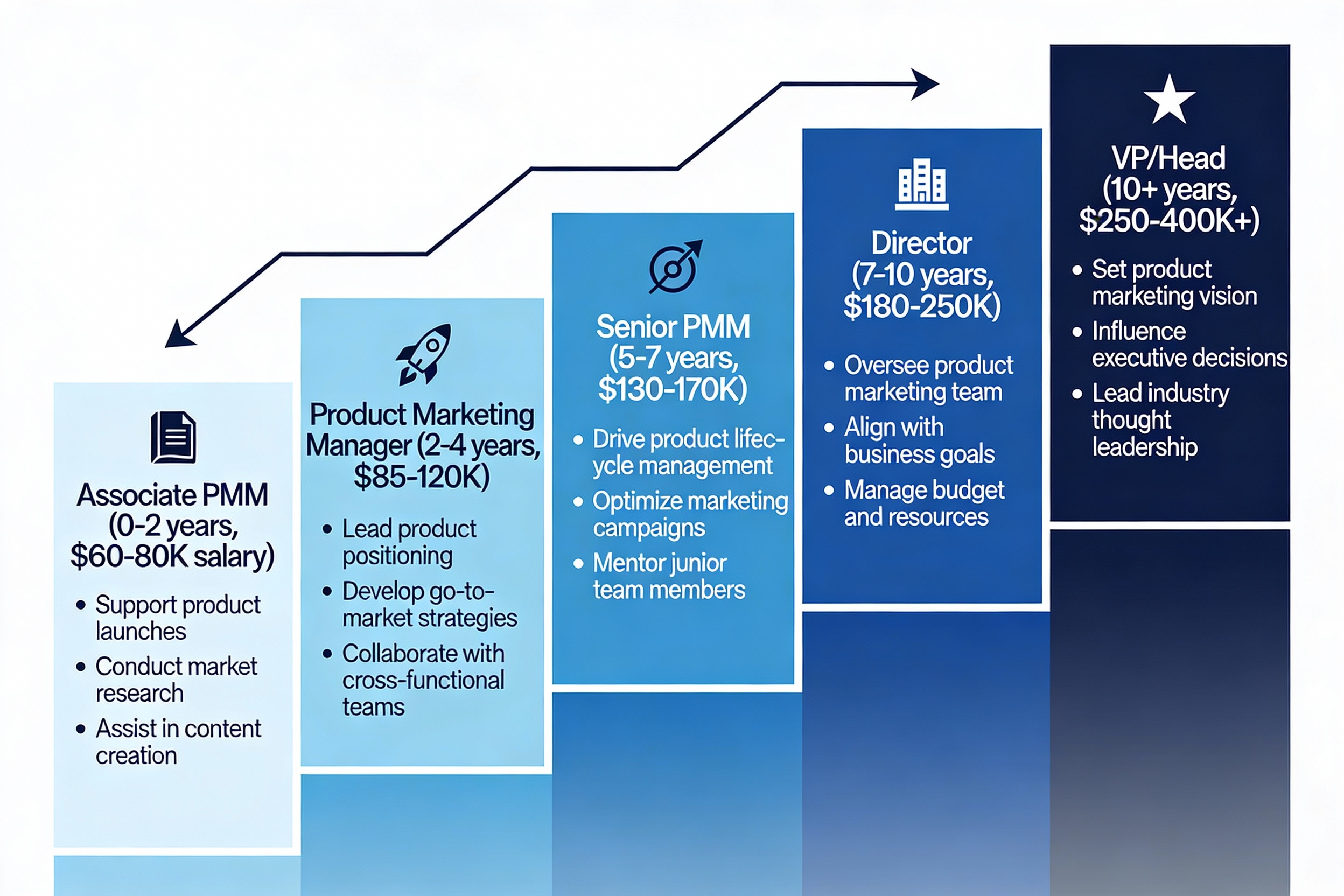
Product marketing careers follow a clear progression path based on expertise, leadership responsibility, and strategic impact:
Associate Product Marketing Manager (Entry-Level)
This is typically your starting position if transitioning from adjacent fields. You’ll focus on supporting basic product launch activities, learning customer personas, and building foundational research skills. You’ll shadow senior PMMs and collaborate across teams to understand how information flows between marketing, product, and sales.
Product Marketing Manager (Mid-Level)
At this stage, you own go-to-market plans for specific products or product lines, create positioning and messaging strategies, develop sales enablement tools, and analyze product performance data to refine campaigns. You work directly with sales teams and lead cross-functional collaboration for your product area.
Senior Product Marketing Manager
Senior PMMs set strategic direction for product positioning, lead high-performing teams, own portfolio-level GTM plans, anticipate market shifts, and serve as a trusted advisor to executives. You drive cross-functional orchestration and provide market insights that shape investment decisions.
Manager of Product Marketing / Director
At this leadership level, you build and mentor teams, establish best practices across PMMs, oversee multiple product portfolios, and influence organizational strategy at an executive level.
VP / Senior Director of Product Marketing
You own the company’s market narrative, guide multi-year growth strategies, oversee global GTM execution, influence C-suite peers, and represent the company externally as a thought leader.
Timeline to PMM Role
-
0-6 months: Learn fundamentals through certifications and build a portfolio
-
6-12 months: Secure entry-level marketing role or PMM associate position
-
1-2 years: Build product marketing experience in adjacent roles
-
2-3 years: Transition to full Product Marketing Manager role
-
3+ years: Progress toward senior and leadership positions
Essential Topics & Core Competencies
1. Market Research & Customer Intelligence
Foundational Knowledge:
-
Conducting quantitative and qualitative market research
-
Using surveys, interviews, and analytics to gather customer insights
-
Identifying target market segments and analyzing demographics
-
Understanding customer pain points and buying behaviors
-
Mapping the customer journey and decision-making process
-
Creating detailed, research-backed buyer personas
Advanced Applications:
-
Jobs-to-be-Done (JTBD) framework for understanding customer motivations
-
Market segmentation strategies and targeting
-
Voice of the customer programs
-
Trend analysis and market opportunity identification
-
Win/loss analysis to understand market positioning
2. Competitive Intelligence & Analysis
Key Topics:
-
Conducting comprehensive competitive landscape analysis
-
Identifying direct and indirect competitors
-
Analyzing competitor positioning, messaging, and go-to-market strategies
-
Tracking competitor product changes and launches
-
Creating competitive battlecards for sales teams
-
Developing objection-handling frameworks
-
SWOT analysis for strategic planning
-
Differentiation strategies in crowded markets
3. Product Positioning & Messaging
This is the core of product marketing work. You must translate customer insights into clear, compelling narratives.
Positioning Framework:
-
Developing positioning statements that define your market position
-
Creating value propositions that resonate with buyer personas
-
Building feature-to-benefit mapping that connects product capabilities to business outcomes
-
Crafting core narratives that explain “why now”
Messaging Architecture:
-
Developing 3-4 value pillars with proof points
-
Creating messaging for different personas and use cases
-
Writing elevator pitches and sales narratives
-
Developing case studies and customer proof points
-
Building thought leadership content
Creating Effective Positioning Statements
A strong positioning statement includes:
-
The customer moment (trigger/event)
-
The cost of the status quo
-
The new approach (your product)
-
Specific proof (case study, metric, or integration)
-
A clear next step for the customer
4. Go-to-Market (GTM) Strategy Development
GTM planning is where strategy meets execution.
GTM Components:
-
Market selection and target audience definition
-
Sales strategy (direct sales, self-serve, hybrid motion)
-
Marketing strategy (demand generation, content, digital channels)
-
Pricing and packaging strategy
-
Channel strategy (direct, indirect, partnerships)
-
Launch sequencing and timing
GTM Planning Process:
-
Conducting total addressable market (TAM) analysis
-
Defining success metrics and KPIs
-
Creating 90-day, 6-month, and 12-month roadmaps
-
Identifying cross-functional dependencies
-
Building launch checklists and playbooks
5. Product Launch Planning & Execution
Product launches are where PMMs orchestrate cross-functional teams to bring products to market successfully.
Launch Planning Topics:
-
Pre-launch research and customer validation
-
Launch timeline creation and milestone tracking
-
Creating launch briefs with goals, messaging, and channel plans
-
Demand generation campaign planning
-
Sales enablement material creation
-
Partner communication strategies
-
Press and analyst relations
-
Post-launch measurement and iteration
Launch Execution:
-
Managing launch timelines and dependencies
-
Coordinating across product, sales, marketing, and customer success teams
-
Monitoring real-time metrics and making adjustments
-
Customer interview and feedback collection during launch
6. Sales Enablement & Support
PMMs are responsible for equipping sales teams to win deals.
Sales Enablement Deliverables:
-
Competitive battlecards with trap-setting questions
-
Sales pitch decks and presentation materials
-
Case studies and customer success stories
-
One-sheets and product overviews
-
Pricing and packaging guides
-
Objection-handling frameworks
-
Role-based training (SDRs, account executives, customer success)
-
Ongoing training and certification programs
7. Analytics, Metrics & Performance Measurement
Data-driven decision-making separates great PMMs from average ones.
Key Metrics to Track:
-
Customer Acquisition: Customer acquisition cost (CAC), customer acquisition by channel, MQLs, SQLs
-
Revenue Impact: Annual recurring revenue (ARR), monthly recurring revenue (MRR), deal size, win rates
-
Product Adoption: Product usage metrics, feature adoption, engagement rates
-
Market Position: Win/loss ratios, competitive displacement, market share
-
Campaign Performance: Cost per lead (CPL), ROI, conversion rates by stage
-
Customer Retention: Customer lifetime value (CLTV), churn rate, expansion revenue
Analytical Skills:
-
Using Google Analytics and advanced analytics platforms
-
Building dashboards and reporting frameworks
-
A/B testing campaign variations
-
Cohort analysis and segmentation
-
Predictive analytics for forecasting
-
Data storytelling and communicating insights
8. Buyer Persona Development
Personas are the foundation of all PMM work.
Persona Components:
-
Demographic information (title, industry, company size)
-
Role responsibilities and goals
-
Pain points and challenges
-
Buying criteria and decision process
-
Information sources and preferences
-
Success metrics and KPIs
-
Objections and concerns
-
Sample questions and conversation starters
Creating Research-Backed Personas:
-
Conducting stakeholder interviews
-
Analyzing customer and prospect data
-
Interviewing sales and customer success teams
-
Surveying target markets
-
Validating assumptions with real customer conversations
9. Content & Asset Creation
PMMs guide the creation of all customer-facing marketing materials.
Content Types:
-
Product datasheets and technical briefs
-
Case studies and customer success stories
-
Whitepapers and research reports
-
ROI calculators and assessment tools
-
Comparison guides and competitive analysis documents
-
Sales presentations and pitch decks
-
Email sequences and nurture campaigns
-
Blog posts and thought leadership articles
-
Webinar scripts and presentation materials
-
Video concepts and storyboards
Asset Strategy:
-
Developing content calendars aligned to buyer journey
-
Creating different content for awareness, consideration, and decision stages
-
Tailoring content to different buyer personas
-
Building asset libraries for reuse and scaling
10. Pricing & Value Communication
Understanding and communicating product value is critical.
Pricing Topics:
-
Value-based pricing strategies
-
Competitor pricing analysis
-
Price sensitivity analysis and research
-
Packaging and tier structure optimization
-
Communicating value in pricing conversations
-
Handling pricing objections
Skills & Competencies Development
Hard Skills (Technical & Functional)
Research & Analysis Skills
-
Market research methodologies (quantitative, qualitative)
-
Data analysis and interpretation
-
Competitive intelligence gathering
-
Customer interview techniques
-
Survey design and analysis
-
Statistical analysis basics
-
Using analytics platforms and dashboards
Strategic Planning Skills
-
Developing positioning and messaging strategies
-
GTM strategy development
-
Launch planning and project management
-
Cross-functional planning and alignment
-
Scenario planning and forecasting
-
Roadmap development
Content & Communication Skills
-
Writing compelling positioning statements
-
Creating persuasive marketing copy
-
Developing sales narratives
-
Building presentation decks
-
Creating case studies and proof points
-
Data visualization and storytelling
Tools & Platform Proficiency
Critical tools for modern PMMs include:
-
CRM Platforms: Salesforce, HubSpot (customer data, sales pipeline, attribution)
-
Analytics: Google Analytics, Tableau, Mixpanel (performance measurement, dashboards)
-
Email/Marketing Automation: HubSpot, Mailchimp, Constant Contact (campaign execution)
-
Project Management: Asana, Monday.com, Jira (launch coordination)
-
Design & Content: Canva, Google Workspace, Adobe Creative Suite (asset creation)
-
A/B Testing: Optimizely, Google Optimize (testing and optimization)
-
Social Media: Hootsuite, Buffer (social engagement and tracking)
Soft Skills (Interpersonal & Leadership)
Communication Skills
The most important skill for product marketers. This includes:
-
Clear written communication (emails, documents, briefs)
-
Persuasive verbal communication (pitches, presentations)
-
Listening and understanding stakeholder needs
-
Adapting communication to different audiences (executives, sales, engineers)
-
Presentation delivery and public speaking
-
Feedback incorporation and collaboration
Storytelling & Data Storytelling
-
Crafting compelling narratives that connect emotionally with audiences
-
Framing products as solutions to customer problems
-
Using data to support narratives and recommendations
-
Explaining complex information in understandable ways
-
Building thought leadership through content
Cross-Functional Collaboration
-
Working effectively with product, sales, marketing, and customer success teams
-
Influencing without direct authority
-
Building consensus across teams
-
Managing competing priorities and interests
-
Coordinating complex, fast-moving projects
Strategic Thinking & Business Acumen
-
Understanding market dynamics and competitive positioning
-
Making data-driven decisions
-
Identifying market opportunities and threats
-
Connecting marketing activities to revenue outcomes
-
Long-term strategic planning
-
Customer empathy and market perspective
Leadership & Influence
-
Building and mentoring teams (as you progress)
-
Providing clear direction and vision
-
Developing talent and coaching others
-
Influencing executives and decision-makers
-
Managing stakeholder relationships
-
Driving organizational alignment around market insights
Education & Certifications
1: Pragmatic Marketing Certification (PMC)
Program Overview:
The Pragmatic Marketing Certification is one of the most recognized credentials in the industry, preferred by many companies.
Certification Path:
To earn the full Product Marketing Certification, complete these three courses:
-
Foundations – Core product marketing principles
-
Market – Market research, competitive analysis, persona development, positioning
-
Launch – Product launch planning, messaging, sales enablement
What You’ll Learn:
-
Assessing market problems
-
Persona development and segmentation
-
Product positioning and goal prioritization
-
Strategic messaging and marketing planning
-
Launch planning and execution strategies
Requirements:
-
No prerequisites
-
Self-paced or instructor-led options
-
Flexible scheduling
Investment:
-
Individual courses: ~$1,000+ each
-
Full certification program: Varies by delivery method
-
Time commitment: 1-3 months depending on pace
Value:
-
Highly recognized in enterprise B2B companies
-
Focus on product marketing foundations and best practices
-
Includes certification badge for LinkedIn and resumes
2: Product Marketing Alliance Certified Core (PMA)
Program Overview:
The Product Marketing Alliance offers one of the most modern and comprehensive product marketing certifications, increasingly popular in tech companies.
Certification Structure:
-
PMA Core Certification – Foundation level
-
Advanced PMA Certification – Deep expertise in launches, GTM, team management
-
Specialist Certifications – PLG, Sales-Led, SaaS, Enterprise
PMA Core Covers:
-
Market research and competitive analysis
-
Messaging and positioning frameworks
-
Go-to-market strategy development
-
Product launch planning
-
Building buyer personas
-
Sales enablement
-
Success metrics and measurement
Program Format:
-
Live Virtual: Full courses with instructors and peer learning (~$1,299 as of 2025)
-
Self-Paced: Recorded modules with flexibility
-
Duration: 4-6 weeks for core certification (can be accelerated)
Unique Advantages:
-
Built with input from PMMs at Adobe, Google, LinkedIn, Atlassian, Grammarly
-
Practical templates and frameworks you can use immediately
-
Access to global product marketing community (500,000+ members)
-
Optional mentorship calls (Thursdays)
-
Accredited by Chartered Institute of Marketing (CIM) and CPD
Advanced Pathways:
After core, progress to:
-
Advanced Product Marketing Certified (execute launches, own GTM strategies, manage teams, build organizations)
-
Leadership Development Program
3: Cornell University eCornell Product Marketing Certificate
Program Overview:
A university-level credential from Cornell Johnson Graduate School of Management.
What You’ll Earn:
-
Product Marketing Certificate from Cornell Johnson
-
40 Professional Development Hours (4 CEUs)
-
20 PDCs toward SHRM-CP and SHRM-SCP recertification
-
20 HRCI recertification hours
Program Focus:
-
Positioning and messaging
-
Launch strategy and execution
-
Market analysis and customer insights
-
Go-to-market execution
-
Metrics and ROI measurement
Format:
-
Online, self-paced learning
-
University-level rigor and credentials
-
~4-6 weeks typical completion
Investment:
-
Premium pricing ($2,000-3,000+)
-
Best for career advancement and formal credentials
-
Value: University prestige and comprehensive curriculum
4: Google Digital Marketing & E-commerce Certificate
Program Overview:
An entry-level certificate from Google through Coursera, great for building foundational marketing skills before PMM specialization.
Skills Gained:
-
Digital marketing and e-commerce strategy
-
Digital channel marketing (search, email, social)
-
Marketing analytics and measurement
-
E-commerce store creation and optimization
-
Customer loyalty strategies
Tools Learned:
Google Ads, Google Analytics, Google Search Console, HubSpot, Mailchimp, Hootsuite, Canva, Constant Contact, Shopify
Format:
-
Fully online and self-paced
-
Hands-on projects and assignments
-
Beginner-friendly, no prerequisites
-
~3-6 months completion
Investment:
-
Affordable option ($30-40/month subscription)
-
Quick entry point to digital marketing
-
Best combined with PMM-specific certifications
When to Take: Early in your career transition, before or alongside more specialized PMM certifications
Certification Comparison for 2026
| Certification | Best For | Cost | Duration | Audience |
|---|---|---|---|---|
| Pragmatic PMC | Enterprise B2B focus; recognition | $1,500-2,500 | 1-3 months | Career growth in large orgs |
| PMA Core | Modern tech; practical templates | $1,299+ | 4-6 weeks | Startups/growth companies |
| Cornell eCornell | Academic prestige; career shift | $2,000-3,000 | 4-6 weeks | Formal credentials; career change |
| Google Digital Marketing | Foundation skills; budget-friendly | $30-40/month | 3-6 months | Entry-level to PMM transition |
Recommendation for 2026:
-
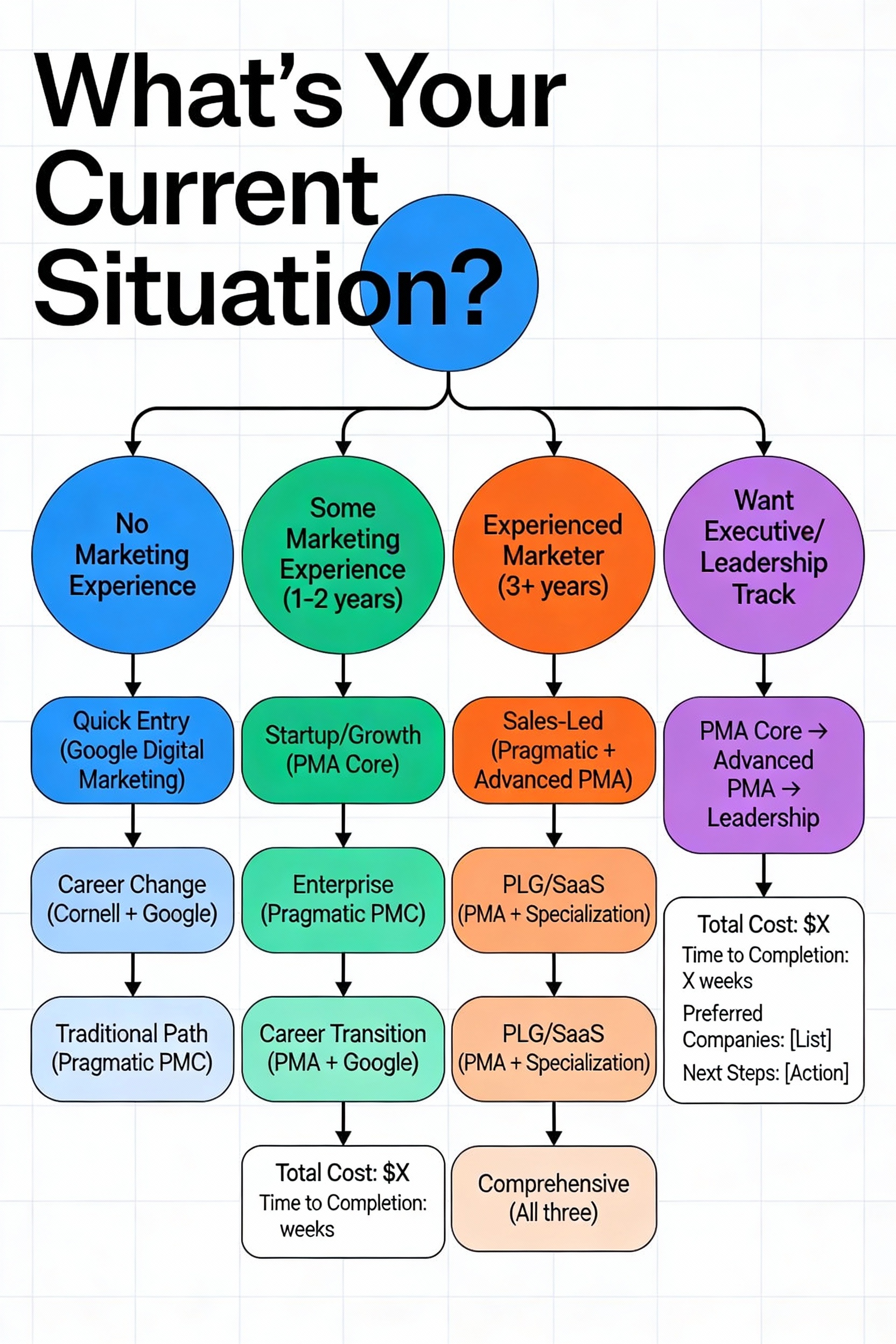
No experience: Start with Google Digital Marketing Certificate, then follow with PMA Core
-
Some marketing background: Go directly to PMA Core or Pragmatic PMC based on company type
-
Switching careers: Cornell eCornell provides academic credibility + PMA Core for practical skills
-
Looking for employment: PMA Core + strong portfolio > single certification
A 12-Month Roadmap
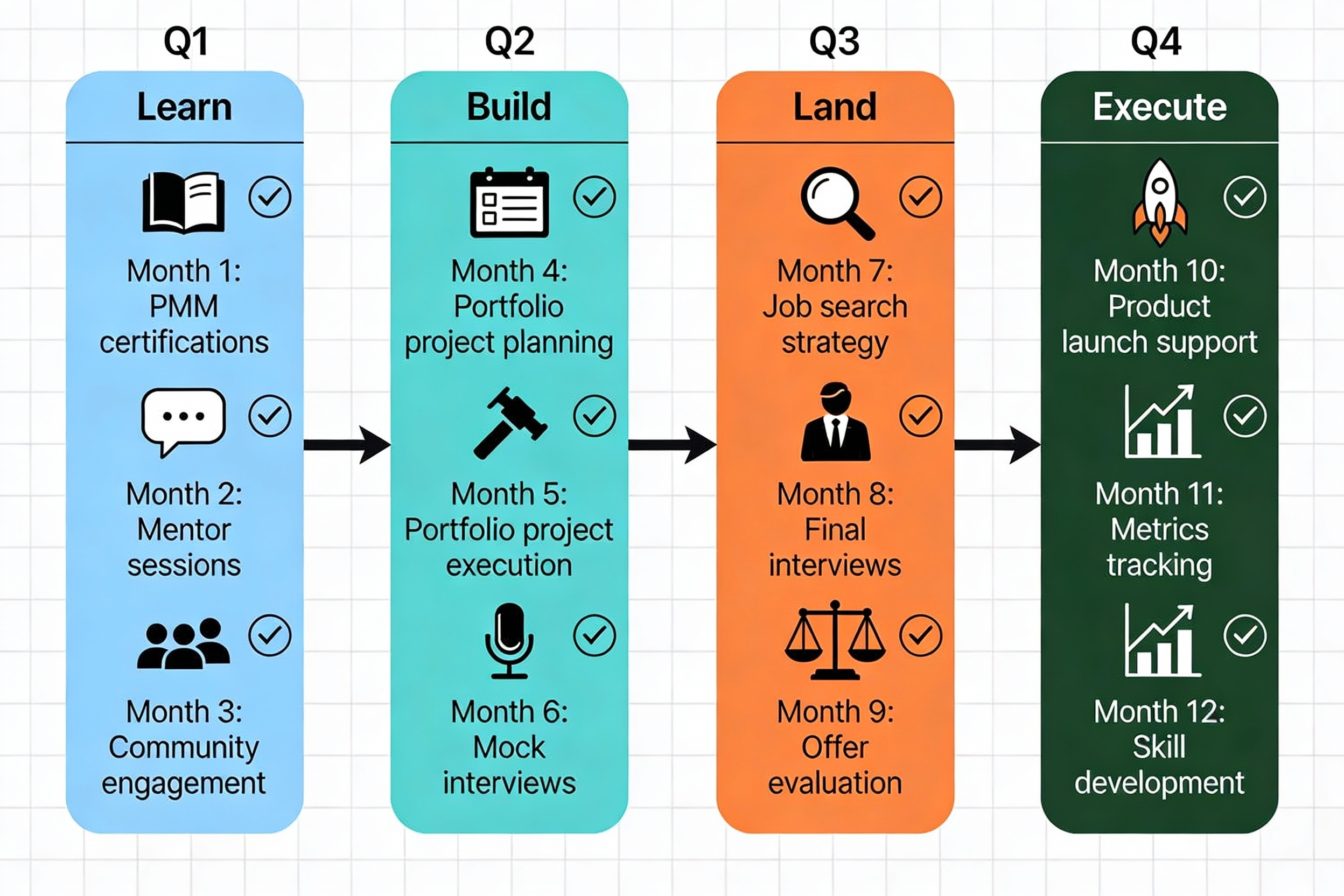
Months 1-2: Foundation Building
Goals: Assess current skills, secure foundational education, build learning network
Actions:
-
Choose and begin foundational certification (PMA Core or Pragmatic Foundations)
-
Take Google Digital Marketing Certificate courses in parallel
-
Join Product Marketing Alliance community and attend virtual events
-
Connect with product marketing mentors on LinkedIn
-
Start reading PMM-focused blogs (Product Marketing Alliance, Pragmatic Institute)
-
Analyze 3-5 competitor positioning statements in your target industry
-
Follow industry analysts and thought leaders on Twitter/LinkedIn
Deliverables:
-
1-2 foundational certifications started
-
PMM mentor identified
-
Competitive analysis document (3-5 competitors)
Months 3-4: Practical Application
Goals: Build hands-on experience, create portfolio projects
Actions:
-
Complete foundational certifications
-
Develop a personal “sample positioning statement” for a product you know well
-
Create a mock buyer persona document (2-3 personas) [Read: How to create customer/buyer persona]
-
Build a competitive battlecard for a hypothetical product launch
-
Conduct 5-10 customer interviews (can be informational interviews if not working)
-
Create a go-to-market strategy template for a product in your target space
-
Take advanced courses on messaging and positioning
Deliverables:
-
2-3 portfolio projects (positioning doc, personas, battlecard)
-
Customer insights summary from interviews
-
GTM strategy template
-
Certification completion
Months 5-6: Role Transition
Goals: Secure entry-level marketing role or PMM associate position
Actions:
-
Tailor resume to highlight market research, messaging, and GTM skills
-
Apply for: Marketing Manager, PMM Associate, Growth Marketing, Demand Gen roles
-
Leverage LinkedIn network and informational interviews
-
Prepare case studies from certification projects
-
Practice interviewing and presenting your PMM projects
-
Target companies known for PMM excellence (Adobe, Atlassian, Grammarly, HubSpot)
Deliverables:
-
Updated LinkedIn profile with PMM focus
-
Resume highlighting relevant projects
-
Case studies showing PMM work
-
Job interviews lined up
Months 7-12: Experience Building
Goals: Develop hands-on product marketing experience
Actions:
-
Secure position as PMM Associate or adjacent marketing role
-
Volunteer for: product launch projects, messaging development, sales enablement
-
Conduct market research and create buyer personas for your company’s products
-
Develop positioning statements and messaging frameworks
-
Create sales enablement materials (battlecards, one-sheets, pitch decks)
-
Support product launch planning and execution
-
Develop metrics dashboard for your product area
-
Build relationships with sales, product, and customer success teams
-
Attend PMM conferences and industry events
-
Take advanced PMM certification course (Advanced PMA or Pragmatic Launch)
Deliverables:
-
2-3 completed product launches or major projects
-
Sales enablement materials in use by team
-
Positioning/messaging documentation
-
Metrics and performance dashboard
-
1-2 customer case studies or testimonials
Building Your Product Marketing Skill Stack
Core Courses & Learning Paths
Beyond certifications, these courses develop specific PMM skills:
Positioning & Messaging
-
“The 22 Immutable Laws of Branding” – Al Ries & Laura Ries (book)
-
“Positioning: The Battle for Your Mind” (foundational book)
-
PMA Positioning & Messaging course
-
Pragmatic “Market” course module on positioning
-
“Creating Winning Products” courses (various platforms)
Go-to-Market Strategy
-
PMA Go-to-Market course
-
“Lean Product and Process Development” (LPDT) course
-
Scaling Your Product Marketing course
-
B2B SaaS GTM masterclasses (various instructors)
Market Research & Competitive Analysis
-
“Market Research & Competitive Analysis” – Coursera (Xbox course)
-
Pragmatic “Market” course
-
Customer interview and research methodologies workshops
-
Jobs to Be Done (JTBD) training courses
Product Launch Execution
-
PMA Product Launch course
-
Pragmatic “Launch” course
-
Product launch playbooks and checklists
-
Real-world case study analysis
Sales Enablement
-
Sales enablement best practices workshops
-
Creating competitive battlecards – online courses
-
Sales presentation and pitch training
-
Objection handling frameworks course
Data Analysis & Metrics
-
Google Analytics certification
-
Data analytics for marketers courses
-
Dashboard and reporting workshops
-
“Lean Analytics” book + course
-
Marketing attribution modeling
Communication & Storytelling
-
Presentation skills: Toastmasters, Coursera presentation courses
-
Technical writing courses
-
Data storytelling workshops
-
Sales presentation training
-
Content creation and copywriting courses
Marketing Tools & Platforms
-
HubSpot: HubSpot Academy free certifications (CRM, Email, Content, Analytics)
-
Salesforce: Trailhead learning platform (free)
-
Google Ads: Google Skillshop certifications (free)
-
Tableau: Free training and community
-
Platform-specific certifications for tools used at your company
Recommended Learning Stack for 2026
| Skills Area | Course/Certification | Time | Cost |
|---|---|---|---|
| Foundations | PMA Core OR Pragmatic PMC | 6 weeks | $1,200-2,000 |
| Positioning | PMA Positioning or Pragmatic Market | 2-3 weeks | Included above |
| GTM Strategy | Advanced PMA or GTM masterclass | 3-4 weeks | $500-1,000 |
| Analytics | Google Analytics + Data Storytelling | 4 weeks | Free-$200 |
| Tools | HubSpot + Salesforce Trailhead | 2-3 weeks | Free |
| Storytelling | Presentation/Communication course | 2-3 weeks | $100-300 |
| Launches | Launch execution workshops | 2-3 weeks | $300-500 |
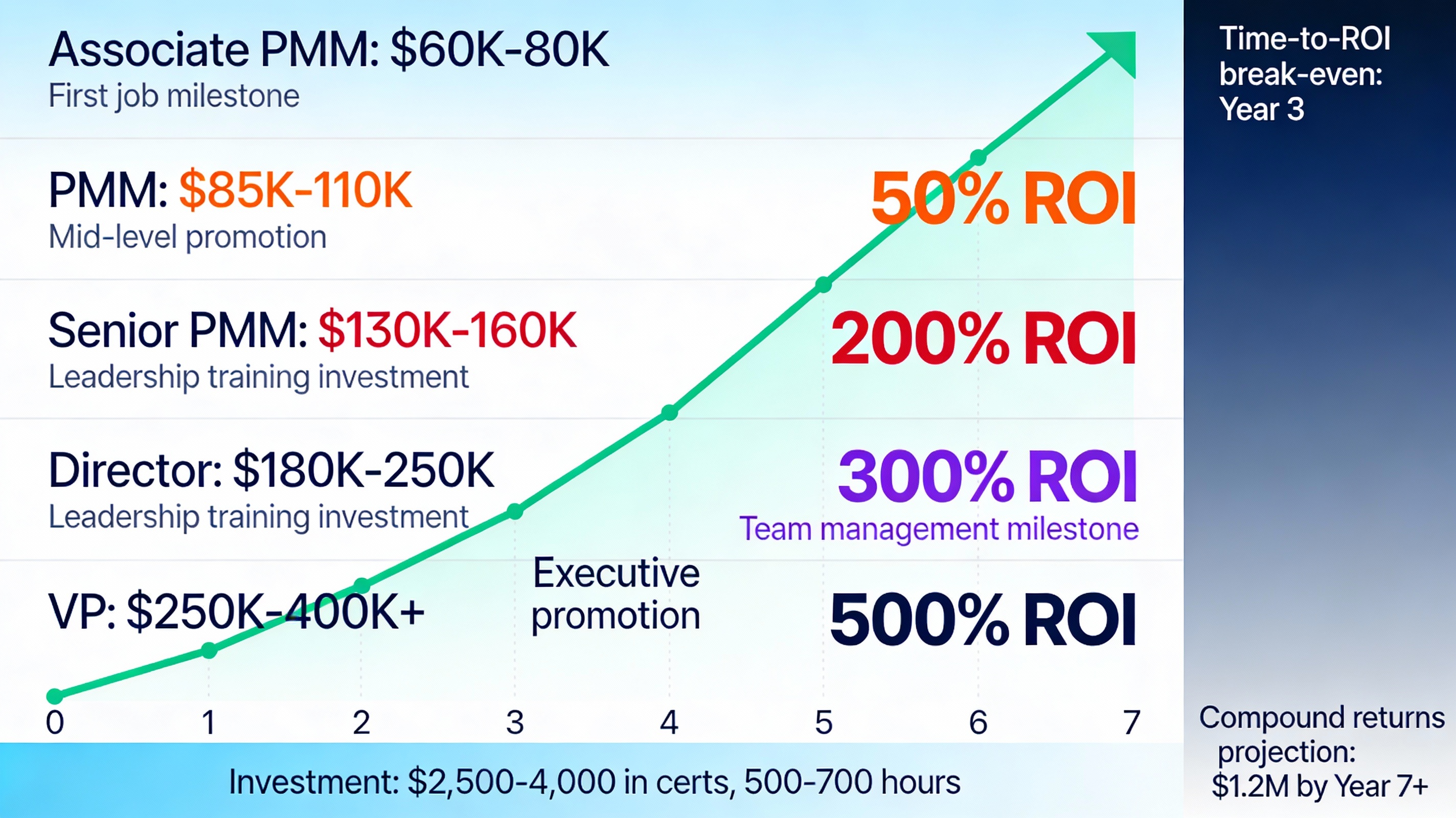
| Total Time Investment | 3-6 months intensive | $2,200-4,000 |
Becoming a product marketing manager in 2026 is achievable through a structured combination of certifications, hands-on experience, and continuous learning. The field values both strategic thinking and tactical execution, making it an excellent career path for those who enjoy the intersection of market insights, product strategy, and customer communication.
Start with foundational certifications, build a portfolio of real projects, gain experience in marketing or adjacent roles, and continuously develop your skills through practice and advanced learning. Within 12-18 months of focused effort, you can transition into your first dedicated PMM role and begin a rewarding career at the heart of product success.
The key is to start now, certifications combined with hands-on project work will position you for success in this increasingly critical role.